
District 7 Councilor Miniard Culpepper is up against an end-of-June deadline to save Boston’s fare-free bus program, but he can’t do it alone.
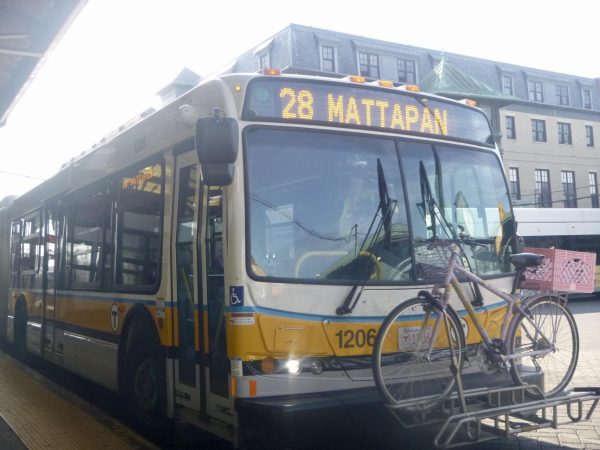
Boston’s fare-free bus program for bus routes 23, 28 and 29 is set to end on June 30. The program’s cancellation will impact the riders who rely on the buses.
According to the city, the program increased bus ridership, saved residents money, cleared congested roads and improved travel times. The buses run through Roxbury, Mattapan and Dorchester.
Residents in these neighborhoods, many of which are low-income, rely heavily on bus transportation for their daily lives, as there is limited access to trains. The fare-free bus program was a solution to promote transit equity and relieve low-income riders.
The program was originally funded through COVID-era federal grants. Those funds expire this year. There is currently no money in the city budget or MBTA budget to continue the program past June.
The city pays the MBTA $350,000 a month to run the program.
For comparison, in 2024, the Boston Police Department spent over $100 million on overtime, at just under $8.5 million a month. The cost of running the bus program is just a fraction of that money, and one month of police overtime funds could run the program for nearly two years.
Culpepper has proposed two solutions. One is a resolution urging the MBTA to cancel proposed center-running bus lanes along Blue Hill Ave. and reallocate those funds to the program. The other is a hearing to examine options to extend and fund the bus program.
While Culpepper has engaged with this issue and shared his two potential solutions, it is unclear what elected officials who ran on the expansion of fare-free transit have planned. The Scope reached out to Mayor Michelle Wu and City Councilor At-Large Julia Mejia multiple times, but neither agreed to answer questions about this topic.
Many residents affected by these routes depend on transit because they have limited access to personal cars.
Carmela Rivera, who occasionally takes Route 23, uses the bus for “everything.” Buses are essential to her daily life. Without them, she would not be able to get to doctor’s appointments, work or the grocery store.
“It is important to have buses. I don’t have a car, so without them, I wouldn’t be able to get to where I need to be,” she said.
The communities impacted do not have nearby access to the trains that are widely used throughout the city. This is a transit “gap” within these neighborhoods, said Emmanuell De Barros, Director of Development and Community Engagement at Alternatives for Community & Environment (A.C.E.).
“These communities are impacted because they don’t have rapid transit, but also, they do suffer from congestion due to transportation and traffic,” said De Barros. A.C.E. has an initiative, the T-Riders Union, that focuses on transportation equity.
“We do not have a train for the Orange and the Red Line, and these two lines are the ones making this gap,” said De Barros. “So these three buses are actually serving the right community because they don’t have good public transportation in these areas, but it’s making sure that they’re able to get to places in an affordable way.”
Councilor Culpepper supports the program as Routes 23, 28 and 29 all run through his district.
“I think for people that are struggling, for poor people, it made a heck of a lot of difference, and them getting to and from where they had to go,” said Culpepper. “Some people walk to work, with that [the buses], they didn’t have to work anymore because they could take the bus free.”
The MBTA’s income-eligible reduced fare program cuts the cost of a bus ride in half, with riders paying $0.85 for a one-way fare instead of $1.70. Riders are saving approximately $50 a month.
“The reason why I am fighting so hard for the free bus lane is because the money that people say taking the bus goes to put food on their table. Goes to help pay their rent. Goes to a winter jacket on their kids,” said Culpepper. “That savings makes a big difference in the budget of someone that’s trying to make the ends meet.”
“It will make an impact on the demographics of the neighborhood that they serve because they serve poverty-level neighborhoods. And it will have an impact on them, and perhaps me, if I need a free ride,” said Willie McCoy, a frequent user of Route 23.
Although he does not personally utilize the fare-free buses, McCoy describes the importance of buses within Roxbury as “ultimate, very important, and essential.”
“This was really a reliable system and waiting for people to commute to work, commute to their educational facilities, schools, or college and universities,” said De Barros. “Also, we were thinking about folks getting to the health facilities in an equitable and affordable way.”
The Boston City Council is currently in discussion about the future of the bus program, and bus riders should know what is to come of the program by mid-June, when the city’s budget is due.
There is not currently a date for Councilor Culpepper’s hearing.
Culpepper has long opposed the addition of center-running bus lanes as part of the Blue Hill Avenue Transportation Action Plan. The plan also includes the addition of crosswalks, enhanced bus stations, and green infrastructure.
“We wanted to transfer at least a year’s worth of the center bus lane money to the free buses so that for the next year, folks would be able to take the free bus,” said Culpepper. “In the meantime, we could look at other monies to continue the free bus program.”
The councilor’s hopes to cancel the center-running bus lanes and allocate those funds to the fare-free program might be a non-starter, as the Blue Hill Avenue Plan’s federal funding is for the design of the new bus lanes.
De Barros discussed his hope for continued progress. He shared that a statewide coalition for transportation justice, T for Mass (Transportation for Massachusetts), has a campaign to make all bus routes free.
“You can see similar things happening in other transportation systems in Central and Western Massachusetts. They had a big victory for the RTA (Regional Transportation Authorities) when they [got the] equivalent of free transportation routes for their transportation systems,” said De Barros.
Fare-free pilot programs have sprung up throughout Massachusetts in recent years. Like Boston’s program, many of these programs began with Covid-era federal grants to increase ridership after the pandemic. As the funds have dwindled, the programs often remain temporary or face uncertain futures.
While many programs await yearly extensions, Merrimack Valley Transit (MeVa) has incorporated fare-free transit into its model, making it the only pilot program to turn permanent.
MeVa’s free fares originally started as a pilot in 2019 but expanded systemwide in March 2022. The program expansion was funded through federal COVID-era relief funds. As of 2025, the board voted to make the fare-free policy permanent.
MeVa’s annual budget is $32 million. Niorka Mendez-Almonte, Deputy Administrator at MeVa, said that while the RTAs receive federal and state funds, they find a lot of funding themselves.
Mendez-Almonte praised their Development Director, Christina Minicucci, for the work she does in securing funds – whether that be through philanthropy or grants, like the Transit Connectivity Grant they recently received from MassDOT (Massachusetts Department of Transportation).
If RTAs like MeVa can receive state funding, it begs the question: can Boston ask for that funding too?
Aaron Michlewitz, Massachusetts State Representative for the 3rd Suffolk District and Chairman of the House Ways and Means Committee, helps allocate funds throughout the state.
This year’s budget proposal allocates about $1.4 billion directly to the MBTA, along with an additional $470 million from its revenue sources. The proposal would allocate $235 million for fare-free fixed routes and Americans with Disabilities Act compliance services to other regional transit systems.
While the state has not allocated any fare-free funds to the MBTA, they have for other transit organizations across the state.
Michlewitz explained the many factors and difficulty of deciding who gets that funding, saying that the regional organisations are filling the gaps of where the MBTA ends and are less frequent.
“We have done a program over the last couple of years using the Fair Share of the Millionaire’s Tax money to help fund a fare-free program related to that,” said Michlewitz. The Fair Share Amendment of the Millionaires’ Tax requires revenue from the tax to go directly to education and transportation.
He continued, “We have not done that with the MBTA. The MBTA, it’s much more expensive. It would be much more expensive of an endeavor, and we just don’t have the revenue sources to do so right now.”
The state, alongside the MBTA, has prioritized efficiency and safety over fare-free programs. Michlewitz cited the MBTA’s history of inefficient service, train cars catching on fire, poor platform maintenance, ceiling tiles falling and train derailments.
“Getting us to a better, a more reliable and safer public transit system has been the priority… and getting us to a place where we can become a public transit system that we can be proud of has been the priority, not as much the fare-free,” said Michlewitz.
Fare-free funding for the MBTA is not off the table for the MBTA’s future, according to Michlewitz.
One reason MeVa found the fare-free transition easier is that the company did not see much revenue from fares to begin with. For every $1 collected at fareboxes, they only saw 23.9 cents in revenue.
Every transit authority is different, and while some have high revenue streams, MeVa did not. Between employing people to work the “money room” every day, maintenance of sales boxes and other expenses, Mendez-Almonte added, “so much effort for 23.9 cents really wasn’t cutting it.”
Mendez-Almonte started as a bus driver 12 years ago.
“I can tell you from experience, those boxes were constantly breaking down,” she shared. “It’s affecting your on-time performance. It creates issues and arguments between the drivers and the riders. It just creates delays.”
In addition to increased ridership, cost savings for residents, more reliable service and increased accessibility to workplaces, grocery stores and healthcare facilities, Mendez-Almonte shared an unexpected reward: the mental health benefits of social interaction.
“I didn’t know how impactful public transit was before I drove because I never took a bus but driving made me realize that some of these people… do not have anyone to talk to all day… and maybe the only person that greets them or talks to them is a bus driver or another passenger,” said Mendez-Almonte.
MeVa’s administration went on ride-alongs to learn about drivers and riders beyond the data they were receiving; they wanted to hear stories. Mendez-Almonte shared a story of how essential the buses became to six women living in elderly housing.
“They were like, ‘Oh my god, if it wasn’t for you, we don’t know where we would be,” said Mendez-Almonte. She continued, “Not only do they get access to these special services, but it’s also the mental health part of it, right? They get to talk to people, they go outside, they’re not stuck inside their houses because they cannot drive.”
One criticism of fare-free transit is the possibility of less frequent services. MeVa recently added two new routes, extended hours, and increased frequency for its more popular routes.
“We want a similar thing throughout the MBTA. We saw this [the fare-free program] as a start, and we just wanted to make sure the city of Boston maintains it,” said De Barros. He hopes for a day when all bus routes are free.
If the program ends, the MBTA still offers reduced fares for eligible groups.