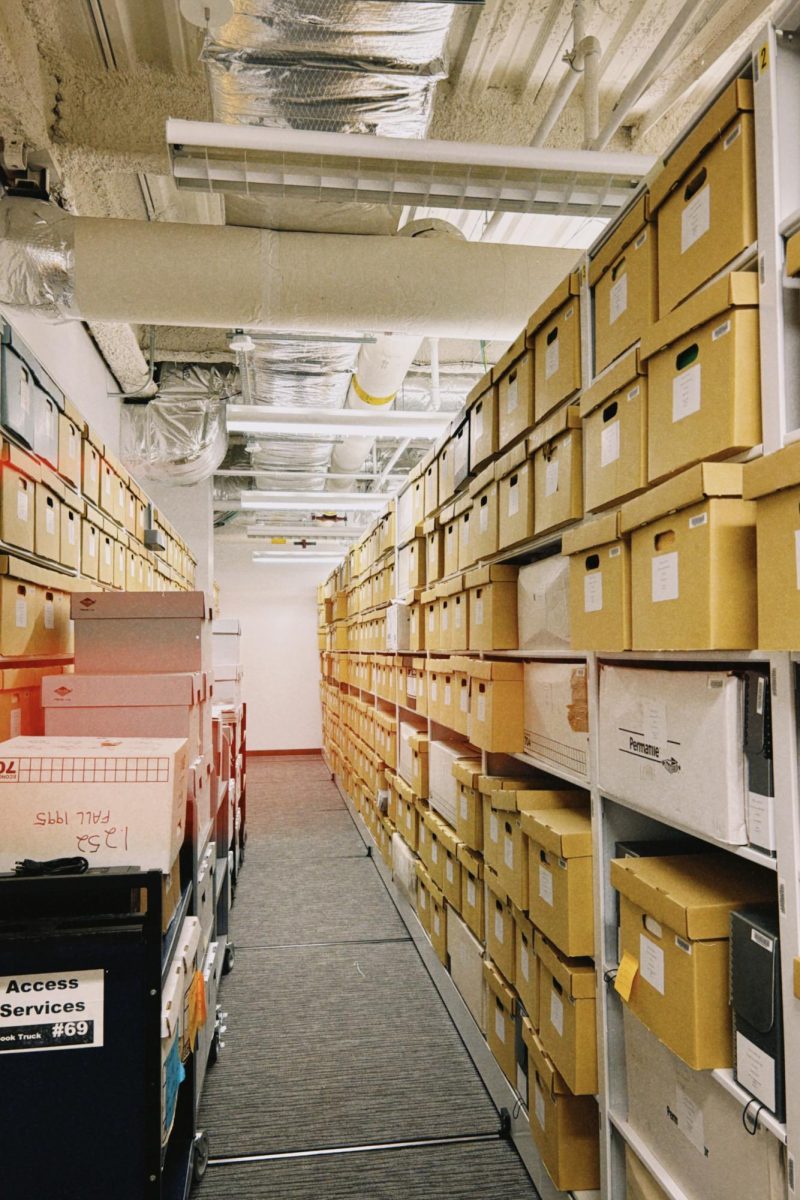
Tucked away in basements all over Boston sit stories of the city’s historically Black neighborhoods, stories only ever told between reminiscent old friends and by grandparents to their grandchildren.
Photos, documents and video tapes are just a few of the items waiting in archives to be discovered. Independent archivists like Ebony Gill are dusting them off, working toward making sure history paints a more complete picture of Boston’s past. Most archival material has never seen the internet, but Gill has the power to digitally preserve these memories before they crumble or are lost.
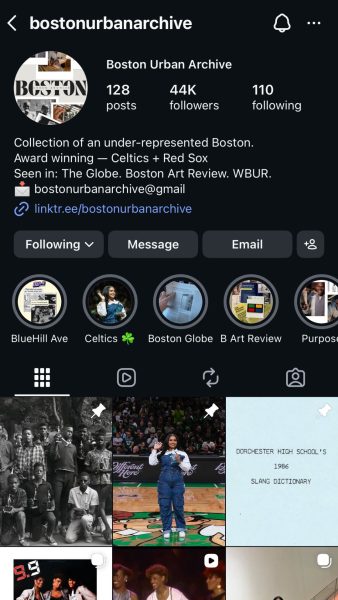
Gill, a 2024 UMass Boston graduate, is the founder of Boston Urban Archive, an Instagram account with more than 44,000 followers that highlights the city’s underrepresented narratives. She is part of a trend of community members using social media to surface archival stories.
“I think it’s important that we tell our stories, our parents’ stories and our grandparents’ stories. I feel like we all have a responsibility to do that and to do it with care and authenticity. To not allow narratives to be changed and people to go underrepresented,” said Gill.
One of Gill’s goals with her platform is to showcase the Black Boston culture she grew up loving as opposed to the Boston of Matt Damon and Ben Affleck that is overly represented in mainstream media. She always had a love for documentaries, but it wasn’t until she took a journalism class at UMass that she decided to try her hand at storytelling.
While digging through the Boston TV News Digital Library, Gill came across a 1990 video of young Black boys playing basketball in Franklin Field.
Gill cut sections of the video together, threw a classic 90s track over it and hit post.
Comments began flooding in, reading, “R.I.P. Emoe” over and over again.
Unbeknownst to Gill, the 1990 video clip was taken by a reporter covering a curfew set in place for teenagers in the city in response to the rape and murder of a 26-year-old woman in Franklin Field. At the time, WGBH reported that the crime was gang related. In the video, the reporter asks the group of young children playing basketball if they’d abide by the curfew in a few years.
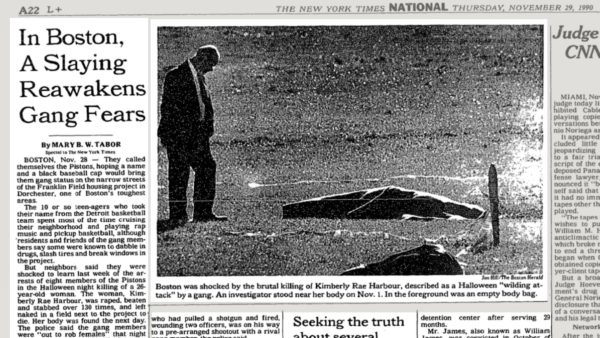
Source: Boston Public Library Archives & Special Collections
“I be out here playing basketball minding my business,” Eric “Emoe” Paulding responded to the reporter.
Seven years later, Paulding was shot and killed not far from where the video was recorded.
Paulding’s death marked the end of a two-and-a-half-year stretch in which no youth were killed by a gun or knife in Boston.
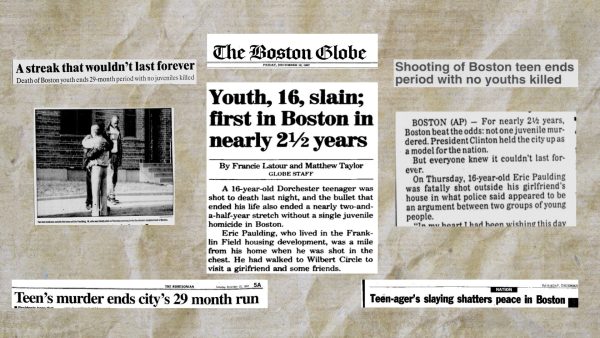
Source: Boston Public Library Archives & Special Collections
“His grandma who’s still alive was able to watch that,” said Gill.
By sharing a video of Paulding alive and with his friends, Gill was able to give a family back a piece of their heart.
“I even tagged his aunt in the video like ‘Oh my God, did you see this? Look at Eric,’” said Tamika Celestin who grew up in Franklin Field with Paulding.
“[His aunt] was like ‘we just did not expect to see our nephew who passed over 20 years ago on social media,’” Gill added. “I was able to connect with his family and bring this memory back decades later through social media and have everyone from the neighborhood see this. They haven’t ever seen it before.”
Archives are more than just old photos and random newspaper clippings. These collections hold songs that revolutionized the music industry, meeting minutes of groups fighting for equality and stories of lives tragically lost. They inform us of who we are today. And for some, they can be a springboard for healing and an opportunity for restoration.
“In some families, this violent horrible incident happens. That trauma lives with them and is transferred to their children, who often don’t know what happened because people weren’t given the information,” said Gina Nortonsmith, an African American history archivist at Northeastern University’s Archives and Special Collections. “Sometimes just being heard is very healing. It doesn’t bring the person back, but in terms of being able to move forward with your life, being heard is really important.”
Some collections go as far as helping a wrongly accused victim be exonerated. Gill’s work may not have that power yet, but she is helping people all over the city feel heard, and that is just as important in the mission to set records straight.
One of the voices Gill has amplified is a Roxbury native who once headlined the same stages as Queen Latifah. At the age of 17, Tammy “Tam Tam” Hairston was the first female rapper from Boston signed to a major record label.
Gill realized she didn’t know much about Boston’s music history, prompting her to dive into discography records.
“I’ve never really learned that much about Boston outside of the Revolution and colonial times that we studied in school. I’m from here, but I’ve never really looked into the culture and people here,” said Gill.
After discovering tapes and items from Hairston’s superstar days, Gill reached out to her on Instagram wanting to connect and share her story. Weaving together concert flyers and tickets with video clips of performances and interviews, Gill transports viewers back to Tam Tam’s hip hop era.
Thirty-three years after her album “Do it Tam Tam” was released, Hairston was “finally getting her flowers,” said Gill.
“It made me feel so wonderful and honored reading all the comments. It literally made me cry. [I was like] ‘Oh my God I’m still loved,’” said Hairston. “When I can’t sleep at night, I’ll go to the comments and I’ll read them over and over. It’s so beautiful.”
Hairston has a star-studded past, but digital storytelling archivists like Gill make a point to tell stories beyond what would have made headlines. From Black-owned nail salons to kids holding breakdancing battles in Madison Park, the everyday people of Black Boston shaped a wider culture.
“Your work is important, and it’s meaningful. Whether you were successful or not, it was meaningful and people should know about it,” added Nortonsmith.
Redefining Archives
Not only can digital storytelling archivists educate the community, they can inspire others to learn more and visit the archives themselves.
Jessica Snodgrass, research services coordinator at UMass Boston’s Archives and Special Collections says that every time Gill creates a post featuring content sourced from their archive, they receive a few emails from people interested in learning more and visiting the collections.
“She’s putting more eyes on the material which is exactly what we want,” said Snodgrass.
While archives are open to everyone, the task of sorting through material and piecing a story together isn’t easy. It takes a special kind of skill and dedication.
“Sometimes there’s a sort of constellation of records that you’re looking at rather than a timeline or through line. When you come to something in a very literal mindset, archives can be a little tough to work through,” said Molly Brown, reference and outreach archivist at Northeastern. “ [Gill is] making stories, names and events more accessible. Putting that in a language that connects with people is key.”
Telling the stories that sit in archives gives them life and breath beyond its shelves. But experts agree that physical, institutional archives have one foundational difference – preservation.
“[Institutions give] this enduring promise of maintenance, collections care, rehousing, organizing, providing access and scanning until the reasonable future that we can foresee as a people,” said Brown.
There’s no guarantee that everything on the internet will live forever. But we can ensure that physical materials are preserved. If a platform shuts down, like Vine did in 2017, or if it becomes banned, like TikTok almost did in 2025, all data would be lost.
Starting a physical collection and branching out into other aspects of archiving alongside storytelling would be difficult for anyone to do on their own. But Dan Cohen, dean of Northeastern’s library, as well as vice provost for information collaboration and history professor, believes that together, institutions and individuals can have a beautiful “symbiosis.”
“Individuals can have superpowers that institutions can’t necessarily replicate. Individuals are connected in ways that institutions are not to the fiber of the community,” said Cohen.
He explained that there is one form of preservation that archivists refer to as “preservation by neglect.” The photos and antique gadgets sitting in your grandparents’ closets and garages might be collecting dust, but they are still being preserved. Institutions can’t necessarily show up at a person’s house and ask for materials, but an individual can.
“When you’re writing the history of individuals and communities that are less represented in the current historical record, you rely on those kinds of things,” said Cohen.
Gill believes that while she’s been successful in sharing Boston’s underrepresented stories to over 44,000 people through her platform, there is still a plethora of history hidden outside of the archives and in people’s homes.
“People, especially those that aren’t in academia, don’t know that they can donate their boxes of family photos, materials and documents,” said Gill. “I want to put together, with people in the community who want to share their archives, my own database outside of these larger institutions and really connect with people.”
“Losing [those stories] gives the impression that there was a blank, and that is absolutely not true,” said Nortonsmith, the Northeastern archivist. “That is not accurate and not representative of the experience of people. Whether we’re talking about the marginalized group or the group that gets the space in the room.”
It’s not about telling Black stories or white stories. It’s about telling the whole story.
“When you’re from a city, and you look at how it’s represented in mainstream movies and news, and what you’re experiencing is different, I think that’s when you need to focus on representing your community and the people there,” said Gill.