
Nestled among outdoor festivities in the Boston wharf is a Rose Kennedy Greenway oak grove. The native oak trees are a safe haven for specific miniature Bostonians.
Beds of herbaceous perennials sit at the base of the trees, serving as a cushion for caterpillars who attach their chrysalises to the branches above. A strong gust of wind from the harbor has them tumbling down, greeted by a “soft landing,” instead of harsh concrete.
The soft landings are one example of a broad effort by individuals, organizations and city initiatives to promote pollinator habitat in Boston.
“[The perennials] literally look soft. They’re very delicate leaves and they’re very close to the ground,” said Sophia MacNeil, a Greenway horticulturist. “And I think that allows the varying microhabitats underneath those leaves. It’s a way [of] mimicking a natural landscape.”
Teams of pollinator enthusiasts such as MacNeil have joined forces to address a glaring global issue: the decline in pollinator species. Disease, pesticides and habitat deterioration pose threats to species survival and around 22% of native pollinator species in North America are at high risk of extinction, especially native bees.
These perils are especially prominent in urban areas. MacNeil and others provide pollinator habitat by incorporating native plants into the landscape whenever possible.
Encompassing bees, beetles, moths, hummingbirds and butterflies, pollinators are tiny ecosystem indicators that are critical components of global food sources, estimated to be responsible for around one-third of the world’s agricultural yields.
Horticulturists who prioritize pollinators in an urban setting have to get creative, be able to pivot and relinquish control over the vegetation. It’s a community effort. It’s not always convenient, it attracts bees (who sting), and it can look untidy. But it’s better for the ecosystem, especially one under threat of destabilization due to species die-off.

A diverse array of native plant species provides the best habitat for pollinators, native and non-native alike, according to Noah Wilson-Rich, who has a Ph.D. in biology and is the founder of beekeeping company Best Bees Company. He also founded the Urban Bee Lab, a nonprofit that tests the components of honey to learn about the health and diet of honeybees around the country.
“So, for pollinator pathways, having native plants and a range of them seems to be best,” Wilson-Rich said, referring to research published by Urban Bee Lab.
Groups that prioritize pollinator habitats in urban areas do so by placing various species of native plants in commercial and residential garden beds, rooftops and community spaces. The commitment to pollinator habitat extends to refraining from pesticides, leaving leaf litter when possible, offering bee hotels for native solitary species and, of course, creating “soft landings,” under oak trees to encourage falling caterpillar survival.
The Greenway serves as a public park for events and congregation and has staunch ecological practices. Their approach to biodiversity requires making judgements about when to leave an unplanned plant growing, and when to intervene. This approach allows a diverse array of plant species to thrive, providing options for the pollinators.
“It’s a lot of adapting to the conditions,” MacNeil explained. “We have a lot of drought-tolerant species., Sometimes [we let] plants grow if they want to be there instead of pulling them out and like ‘well, you don’t belong here.’”
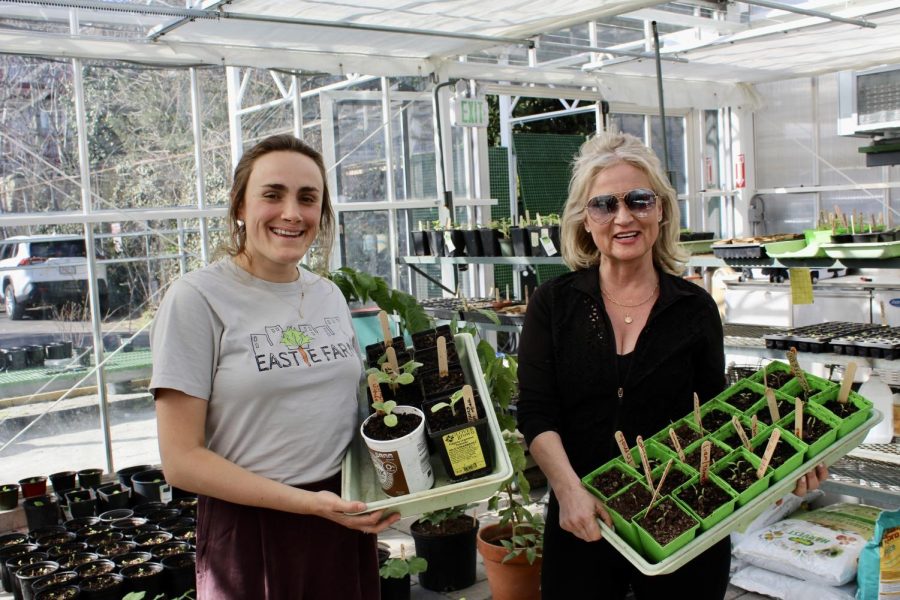
Volunteers help maintain the space, which is an around-the-clock ordeal. Without using pesticides, upkeep is much more labor-intensive.
Being in the middle of Boston poses additional challenges for the horticulturists. Salt from the street, the heat island effect common in cities, trash and varying soil quality all pose a threat to the success of pollinator habitats once planted.
The Greenway is also limited by where they can plant large trees due to soil height constraints. In some places, such as Chinatown, the soil height is as small as 2 feet due to tunnel presence directly beneath.
Trevor Smith, a regenerative land care professional and landscaper of 25 years, is similarly familiar with the challenges of intentional horticulture in the city. Smith’s approach to landscaping in urban areas requires working with the concrete infrastructure in non-traditional ways, with the support of Mayor Michelle Wu.
He previously worked with Weston Nurseries and was instrumental in the bus shelter green roof initiative, which the City of Boston unveiled in 2024. The MBTA bus 28 route, through Mattapan, Dorchester and Roxbury, boasts 29 green-roofed shelters.
The shelters provide a layer of living plant greenery that helps cool the streets during warm summers, reduces the risk of flooding on the streets, and improves plant diversity for pollinators.
Smith has prioritized native plants throughout his two decades of experience as a landscaper, providing pollinator habitat in the process.
“Trying to plant native plants in urban areas is just, like, the biggest oxymoron, because there is nothing native about an urban area,” Smith said. Despite the difficulties of navigating urban infrastructure, he’s perfected the nuances of integrating native plants while planning a garden.
“Creating a garden [is] exactly like writing a menu,” he explained. “I’ll look at the property, look at the conditions of the property, the soil conditions, the light conditions [and] the hydrology, so I can best understand what types of plants will live there.”
Prioritizing native plant species and deliberate pollinator habitat has shown some promising results. A citizen science project on butterfly monitoring employed volunteers to survey butterflies on the Rose Kennedy Greenway.
“Last year we hit a record number of butterfly species that were on the greenway,” said Cameron Frecker, another Greenway horticulturist. In 2025, volunteers counted a total of 484 butterflies and six distinct species, including the Pipevine Swallowtail, which is not typically seen in the northeastern United States.

“But we also just know it’s working because we see our solitary bees, you know, in our bee hotels. We see them out, and we see the plants that rely on them,” Frecker continued. “They keep coming up every year.”
Other pollinator habitat enthusiasts have had similar successes. Brookline Pollinator Pathways, a volunteer-run gardening group in Brookline, has managed to garner town-wide support in a more ground-up approach.
The group has 108 members on its email list and has been a part of 10 community gardens since its founding, including at local schools and libraries. The town of Brookline will help prep the plots of land and provide materials to aid the Pollinator Pathway gardeners.
Brookline town officials will even suggest consulting Pollinator Pathway when they receive requests for new gardens.
“In some ways, Boston’s much more progressive than Brookline. There’s much more green infrastructure already being planned, whether it’s green-roofed bus stops or whatever,” Janice Shotkin explained, referring to the bus shelter green roof initiative. Shotkin is one of the co-leaders of Brookline Pollinator Pathway.
The Brookline Pollinator Pathway has gardens in very visible places, aiding in their ability to get the word out. They place signs with QR codes next to the plots, inviting passersby to learn more about their mission.
“I think the stewardship aspect is really important for what we’re doing in Brookline, and is a difference between, like, the pollinator pathway in Brookline and what’s happening in Boston in terms of ecological sustainability and gardens,” said Ann Walker, another co-leader of the group.
A recent collaboration with the Brookline Parks and Open Space on a “leave the leaves,” initiative encouraged residents to refrain from clearing leaf litter from their lawns, for pollinators and other insect habitat.
In February, Boston City Councilor Sharon Durkan filed an order for a hearing to “explore the inclusion of pollinator corridors as part of [city wide] sustainable development.” The council referred the order to the Planning, Development, & Transportation Committee, where it has yet to be addressed. Councilor Durkan declined to do an interview for this story.
Making small changes to accommodate pollinator habitat in urban areas, however inconvenient, invites pollinator survival.
“Even if the work takes longer [and] requires more hands and more labor,” said MacNeil, the Greenway horticulturist, “we will always opt to do that because we’re prioritizing the biodiversity and the ecosystem.”
Editor’s note: An earlier version of this story incorrectly attributed a quotation to Ann Walker. On May 14, 2026 at 1:15 p.m., the story was updated to correctly attribute that quotation to Janice Shotkin.