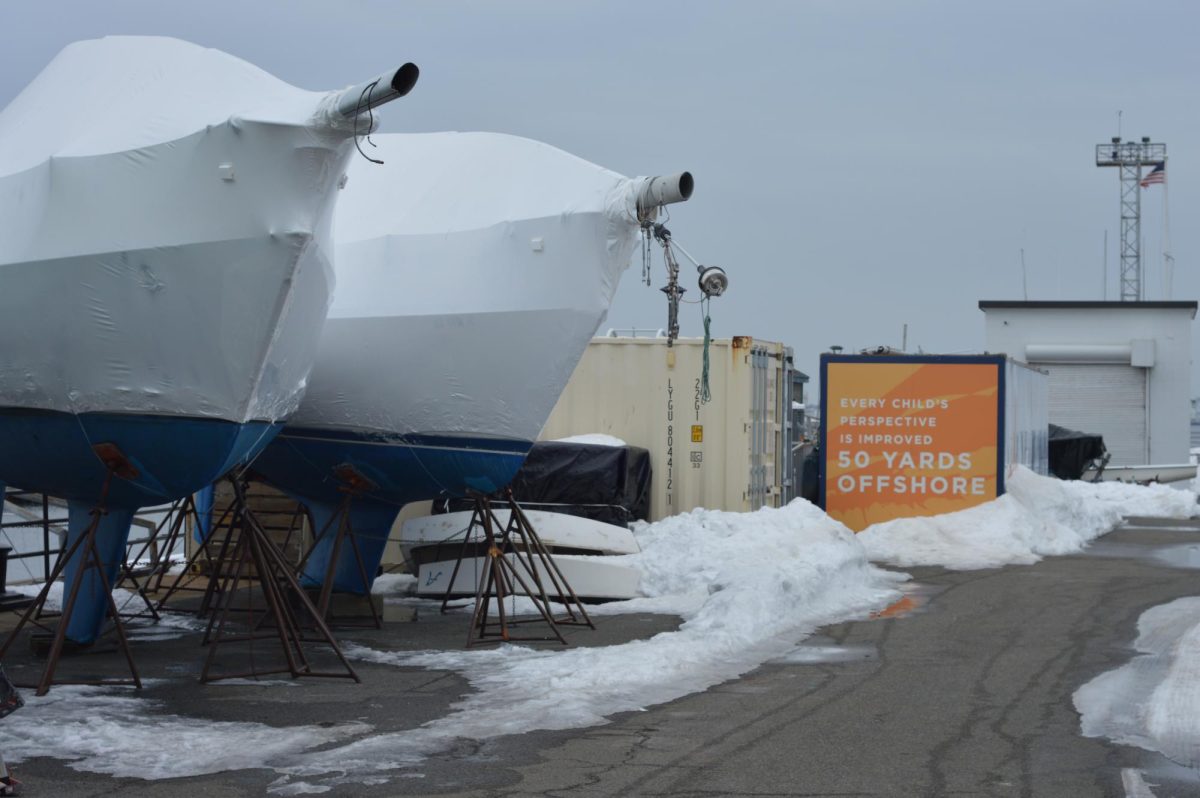
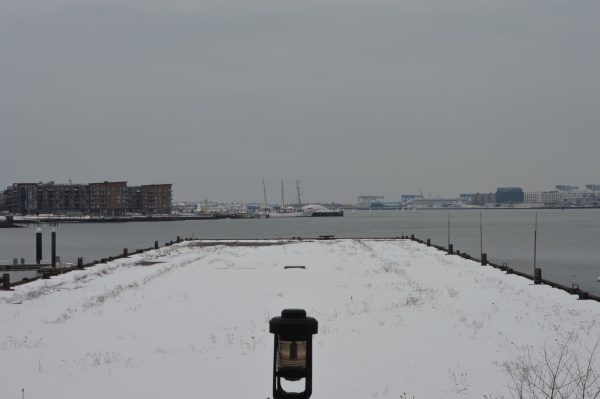
Pier 5 is one of the last undeveloped spaces at the Charlestown Navy Yard. Located far away from the tourist crowds of the USS Constitution, it is abandoned and ringed off by a chain-link fence, with stubborn stalks of weeds poking through the slowly melting snow. While that may sound like an eyesore to some, it looks like the future to Courageous Sailing’s Jennifer Bodde.
Bodde is the education director for Courageous Sailing, as well as running communications and development.
“It’s a nonprofit and we all have about 12 jobs,” she said.
Founded in 1987, Courageous Sailing is dedicated to education through sailing lessons for children and adults in Boston. Housed in nearby Pier 4 behind the Charlestown Navy Yard Park, Courageous prides itself on doing these things as accessible as possible, through scholarships and outreach. To help achieve this, Courageous recently won approval from the Boston Redevelopment and Planning Agency to build a new office and learning complex at next-door Pier 5, thereby doubling their educational capacity.
One of the primary goals of this expansion, Bodde said, “is to have a student body that reflects the diversity of Boston.” Bodde hails from New London, Connecticut, which she said shares certain characteristics with Charlestown as “a waterfront community without the rich people environment that often comes with it… it’s a working-class city.”. That’s part of why she cares about extending sailing opportunities to as many people as possible.
There is no other place in Charlestown that blends past and present like the Charlestown Navy Yard. Almost from the county’s founding, it has mirrored Boston’s fortunes: as it grew from servicing the rig-and-sail ships of the line to World War II destroyers, the Navy Yard was a constant economic engine for the city. However, the same postwar decline that strained Boston led to it being shuttered by the Pentagon in 1975 as part of a post-Vietnam downsizing. Since then, the Navy Yard has become home to museums, offices and living spaces, with several piers being repurposed accordingly.
In a phone interview, Bodde described her hopes for the Pier 5 project, what Courageous means to Charlestown, and how sailing can shed what she describes as its “elitist” image.
This interview has been edited and condensed for clarity.
Q: How long have you been with Courageous Sailing and how did you get involved?
A: I have been full-time since 2013. Before that I would do “learn to sail” for adults for fun. I ran into Dave (Alexander), the executive director, periodically and he kept saying I should join.
Q: What do your duties involve typically?
A: I was hired to develop the adult sailing curriculum. As we started building up our youth/academic program, I became part of that since I was an elementary school math teacher. The only educational component now is coordinating with BPS teachers teaching STEM to older students. Our big thing is connecting academics to what students are experiencing on the water.
Q: How did you get into sailing?
A: I grew up sailing but not [from] a stereotypical background of a rich white girl. Dad painted the boats.
Q: Dave and I spoke about what Courageous does for participants, in regard to the skills it fosters. Can you speak to that?
A: One of my favorite questions for former students who want to be instructors is, “what have you learned from sailing besides sailing?” It demands a lot of skills and so you have to foster them. You need to work together, you need to communicate, you need to have confidence in the decisions you’re making. … “Confidence” is always the biggest thing that people say they find!
Q: How would you describe Courageous’ presence in the Charlestown neighborhood?
A: Within Charlestown, we’re a community resource. There are a lot of adults who took lessons [previously] and a plurality of our students are from Charlestown. For a lot of Charlestown kids, it’s their home down the block.
Q: Dave said that one thing that motivated him is a desire to see sailing shed what he sees as an “elitist” reputation. Do you think it has that reputation and if so, how do you think Courageous has done in confronting that reputation?
A: Yes, it’s a deserved reputation. Community sailing centers are working to address it, but generations of privilege don’t just go away. One of our youth program’s primary goals is to have a student body that reflects the diversity of Boston. Of our summer students, 65% identify as people of color. On the socioeconomic level, 60% are participating for free, based on financial background.
Q: What else needs to be done?
A: I think that yacht clubs and organizations need to be proactive in identifying barriers and dismantling them. It’s not enough to offer scholarships, because there are plenty of families who wouldn’t occur to them to look into these lessons… Charlestown gentrifying was contributing to that, so how do we need to reach people? Is it food? Transportation?
Q: How would you describe the participant intake?
A: There is often a huge element of fear… but watching kids get over that fear or families who are terrified is one of the big victories as an educator.
Q: What are some challenges that you see Courageous or similar sailing programs facing?
A: Nothing unusual these days: Public funding is going down… youth employment programs down for any out-of-school time. Teacher hours have been cut.
Q: Anything else?
A: I would like to put in a plug for the Pier 5 project to turn it into a waterfront community center. The City has approved it, but now we need to figure out how to fund it. There is huge potential for things like floating swimming pools on the pier, among other things.