
Ruth’s Way for Women helps women recovering from substance misuse disorders and encourages empowerment, independence and productivity.
Nicole O’Brien, executive director for Ruth’s Way for Women, founded the non-profit in 2014. Her sobriety journey began in 2007, which had sparked her initiative to help others through their recovery. She took part in Bible studies, worked for the Salvation Army and for an addiction rehabilitation center which led her to create Ruth’s Way for Women.
She noticed that when men transitioned out of the program, they would be hired by well-paying jobs. O’Brien stated that women did not get the same financial stability after transitioning into recovery homes. Many of the women were hired by minimum wage jobs, and they would go back to unhealthy family situations or unhealthy relationships because they had no other options.
“I noticed that when men would leave the program, they would, you know, they’d get a job for about $30 an hour and go into a sober home,” she said. “But women didn’t make that kind of money. For the most part, they would get a job at Dunkin Donuts, and at the time it was like $12 an hour, and they would go back to unhealthy family situations or unhealthy relationships because they had no other options.”
Since beginning Ruth’s Way for Women, she has opened homes in Lynn and Wakefield and hopes to expand into other regions of Greater Boston. She strives to educate and inspire women, taking part in many recovery events across the state and helps facilitate supplies to women in need.
“We encourage women to maybe build a life in the trades which women can make great money at,” said O’Brien. “It’s all about encouraging women to become self-sufficient. We need to learn how to take care of ourselves and be confident in that.”
The Scope sat down for an interview with O’Brien via Zoom. O’Brien spoke about how the program started, the community involvement, the future of the program and how the community can help support this mission. The following conversation has been lightly edited for clarity.
Kirsten Burek: What led you to start Ruth’s Way?
Nicole O’Brien: I’m in long term recovery. My recovery process started in 2007 when I got saved, and I’ve been abstinent from alcohol and pills since 2008. I was working doing Bible studies at the Salvation Army. I became the chaplain up there and worked in their addiction adult rehabilitation center. So, God really put it in my heart to help women, and part of it was to provide sober housing for women, to help women get healthy and well, not just abstain from alcohol and other drugs. So, in 2014 I started the nonprofit. In 2016 we opened our first sober home, which is in Lynn on the Salem line. We opened our second home, which is in Wakefield in 2023.
KB: How is Ruth’s Way involved in the community of Boston and what type of support do you provide?
NO: I worked on Mass Ave doing outreach there, through the Boston Public Health Commission and provided some scholarships for women who wanted to get out of the life, out of the human trafficking … trade. We offer them scholarships to help them out. I’ve also done a lot of outreach with what used to be the East Boston Neighborhood Health Center. [now known as Neighborhood Health] I did a lot of outreach with them, giving out supplies, giving out a little food, helping people to get into detoxes, into shelters, connecting them to food pantries, that type of thing.
KB: I was reading the website, and it lists that women who are enrolled in the program, volunteer, attend school, participate in a program or with an agreed upon productive activity. Can you tell me a little more about these types of programs as well?
NO: Sober housing is not a program. Sober housing is independent living and a structured family environment. We are not licensed through the state, but we have the option to be certified by MASH which is the Massachusetts Alliance for Sober Housing. We don’t want women to abstain from alcohol and other drugs. We want them to get well. We expect the women to either be like in a PHP, which is a partial hospitalization program [or] working doing something productive. The volunteering is only really for women who aren’t capable of holding down a part time job. Some women come in and due to physical, their mental capacity, they’re not able to hold a job. So that’s why we allow women to volunteer.
KB: Can you go into greater detail about what this mission means to you and what Ruth’s Way means to the community overall?
NO: I’ve seen so many women, even myself, growing up with no confidence in themselves in the 60s in the 70s and 80s. This sums it up perfectly: my father, with all good intentions, said to me, “You can be anything you want when you grow up, but hopefully your husband will make enough money so you can stay home with the kids.” That kind of sums up what my generation was taught for the most part. So ,we want to empower women to be the best version of themselves. And I used to be a hot mess, and now I’m just messy, and that’s a good day. And I hope that other women can just find being comfortable and just being messy. That’s what it means to me. We have become, as far as the community, we’ve become a resource, also on the board of WAVE, which is the Wakefield Alliance Against Violence, and the Eastie coalition. What we do is just educate people about how addiction affects domestic violence that affects women, and how we get caught up in the sex trade[and] homelessness. So, the more we can educate people on maybe why we make some of the unhealthy choices that we do, it can help people to be more empathetic and less judgmental. We like to be that bridge and offer resources. We work as a village rather than in silos.
KB: What is your top priority for this organization in the next six to 12 months?
NO: Looking into opening up a residential program for women. Many residential programs in the state closed during COVID, they either closed completely or changed to men’s programs. That’s when women used to come to us. So, they were already sober for three to six months. They had some emotional regulation, and were a little comfortable, and they were sleeping through the night, and they were ready to get a job. Now, because so many of those programs have closed, we’re getting women out of detox and they don’t have any emotional regulation. They’re still going through physical withdrawals most of the time that they come to us. So, by providing that residential program, by the time they’re ready for a sober house, they’ll have that stability. We want to nurture other people. We want to get back to our children. We want to help our elderly parents so we really don’t get as much time to heal that we need, and that’s why we think a residential program will be beneficial for the women that we serve.
KB: I noticed on the website that there is a spring celebration that is scheduled in April. Can you tell me a little bit more about the event?
NO: Yes, so this is our second big fundraising event we had one a year and a half ago and that was for our 10th year anniversary. Now it’s almost, it’ll be almost 12 years in April, and it’s to raise funds. We’re not sure what we’re doing. We’ve been looking at a couple of things. We want, of course, to put money away for scholarships for women, because a lot of women come out of treatment and they don’t have any money and can’t go into sober houses because they don’t have any scholarship money. Or we’d like to get a van so we can drive women to meetings, even though that’s really not part of sober housing. But a lot of them are on a fixed income and they don’t have money to go to meetings. We’re telling them, you have to go to meetings. We can’t just let many women stay for free. Quite often we do, but you know, that’s only when we’re able to. That celebration will be a huge fundraiser to bring income into Ruth’s Way so that we can serve more women and provide them with better resources.
KB: I also read that Ruth’s Way facilitates training/workshops. Can you describe to me what the training and workshops look like, and the importance of helping these women stay sober and stay in sober housing, and how it is beneficial for them?
NO: I’m a certified addictions recovery coach in Massachusetts and a supervisor, and I teach people how to become recovery coaches. We also received a grant that we can go into churches and educate churches about what addiction and recovery really is, so that they can be part of the solution. We also go into businesses, and I’ll teach them what addiction and recovery is and what it actually looks like, so that they could recognize signs with the people that work for them. And they can be part of the solution. They can be helpful. So, we have monthly life skills tonight, and sometimes we have a weekly house meeting. We’re doing an activity on active listening, to teach the women how to actively listen and not just hear something and interpret it the way they, you know, interpret it, not the way that it was intended, but to actually listen to the words. So, in our life skills nights or our house meetings, we might talk about healthy boundaries. We’ll talk about codependence. We’ll talk about unhealthy [relationships] and what a healthy relationship really looks like. We talk about honesty and trust and how much you share with other people, so that by the time the women leave our homes, they have a firm or semi-firm foundation where they have a sponsor or a mentor [and] they’re working [and] they have some steady income. They’re not on time for work, but they’re 15 minutes early for work, which is on time. So we try to instill those skills so that they lead the life that they were always meant to.
KB: If there is one thing that you would like the community of Boston to know about Ruth’s Way, what would it be?
NO: We want to be a resource for the Boston community. I’ve spent most of my life living in East Boston, and I would love to open a sober home or a program in East Boston. It’s just with the prices of real estate, I can’t touch it, but if there was some kind of support that we could get, or a way that we could serve the Boston community. I would just love to be part of that.
KB: I also noticed that last year your nonprofit was running a Supplies of Hope initiative dedicated to meeting the ongoing need for essential cleaning hygiene supplies, ensuring that the sober homes remain welcoming and restorative environments. Are you looking for donations this year? And if so, how can people help out?
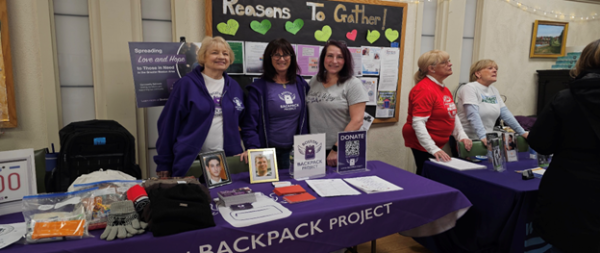
NO: We are always looking for donations, all kinds of donations. People can call, they can reach me by calling me. They can email me. We always need toilet paper, paper towels, napkins, cleaning products and toiletries for the women. We would love for other women to get involved and maybe mentor some of the women in the homes, if there’s a connection there. As any small nonprofit, we’re always looking for funding. So if anyone would like to donate to us, we would love that or even rent us another house, if someone has a property that they don’t know what to do with, if they would be interested in renting it to us as another sober home.
Find more information about Ruth’s Way here.