
The first man to die for American independence was a runaway slave.
Crispus Attucks was shot and killed during the Boston Massacre on March 5, 1770, when British soldiers opened fire in response to an uprising outside the Old State House.
His legacy lives on through the African American Patriots tour in downtown Boston that is being offered every Saturday and Sunday in February in honor of Black History Month. Run by the Freedom Trail Foundation, the tour is also offered on Juneteenth and select weekends during July and August.
Since 2007, the African American Patriots tour has been highlighting “the richness of Black history in Boston,” according to Catherine Benjamin, the programs manager at the foundation, who is responsible for hiring and training guides as well as keeping the tours historically up to date.
“We can always uncover lots of Black history to share, and it’s so important to highlight these kinds of underrepresented stories because it is so much a part of history,” said Benjamin. “It doesn’t make sense for it to be hidden.”
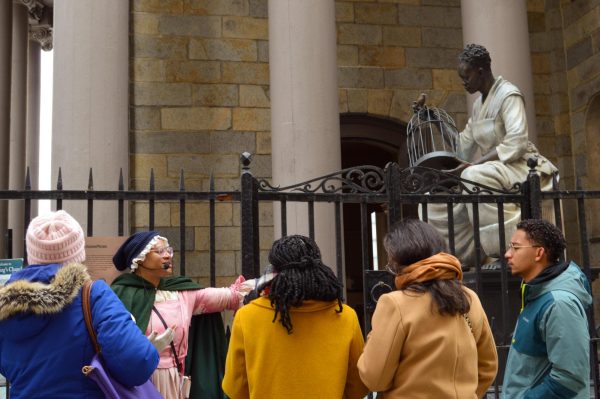
Each tour is led by one of two Freedom Trail Players who take on the persona of either Phillis Wheatley, the first American slave to have her literature published, or Crispus Attucks.
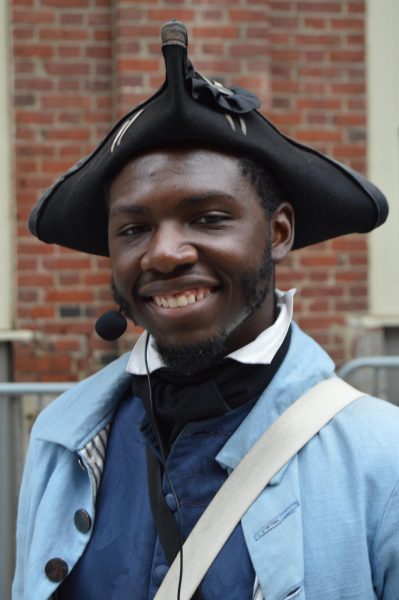
Photo courtesy of Alex Carrigan, Freedom Trail® Foundation.
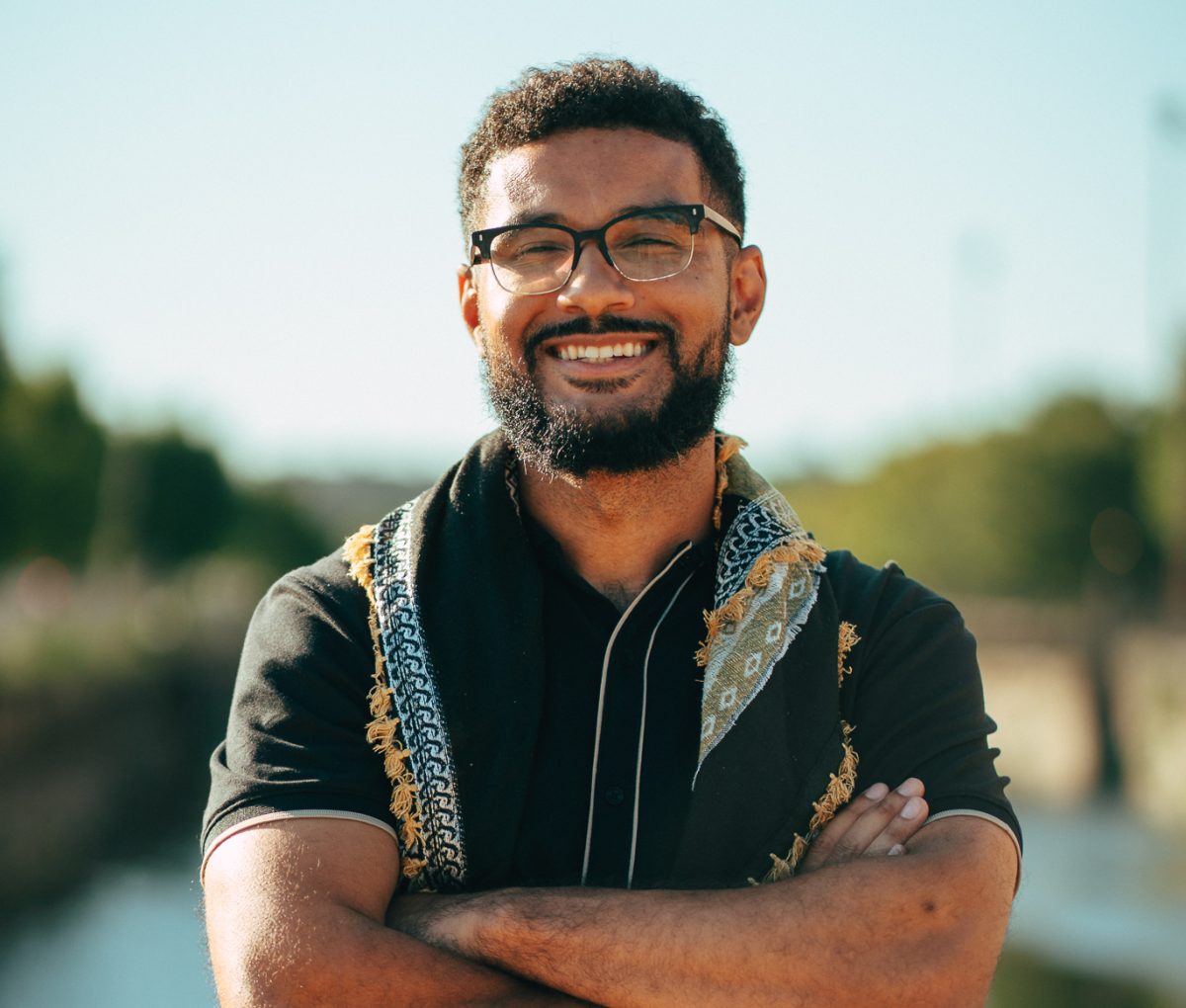
Chris Joazard finds it particularly liberating to play Attucks since there isn’t much known about him prior to his life as a free man. Joazard started giving tours for the foundation while attending UMass Boston and has been doing so for the past eight years.
“There’s all this documentation about who these other characters that I work with are, but there’s so little information about Crispus,” said Joazard. “It’s actually freeing in a way because as an actor I don’t feel beholden to play a certain way.”
One of the creative liberties Joazard takes on his tour is also the root of his most impactful tour memory.
During the 90-minute tour, Joazard reserves a moment to talk about the Underground Railroad, a network of routes that enslaved people travelled in their quest for freedom that included safe houses along the way. As the capital of one of the first states to abolish slavery, Boston was a popular destination for those escaping slavery. The city became a hub for the Underground Railroad with easily accessible ports for those arriving by sea, and homes and churches to hide in throughout Beacon Hill.
“Then I’ll take people down a back alleyway where slaves would escape to other friendly hands to hide another night. I tell people not to say a word and to put themselves in the shoes of those trying to escape with their family, not wanting to make a sound. I’ve had people cry on the other side,” he said.
As he paints the picture of homes being broken into and people being taken and forced down south back into slavery, Joazard cheekily added, “sounds familiar, right?”
On the other side of the alleyway, Joazard said he always gives a speech stressing that this is something people go through to this very day.
“That’s something I’ve said even before what’s been going on in our country now,” he said.
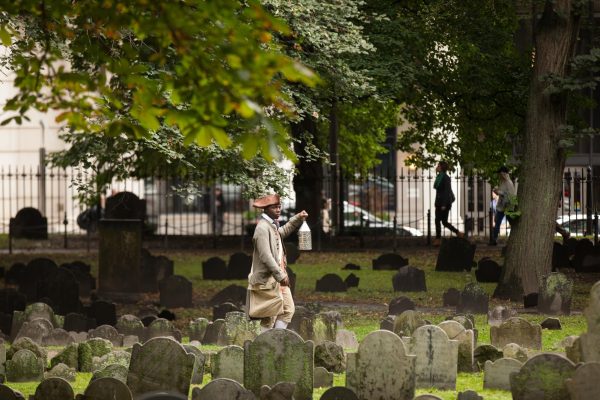
Photo courtesy of Freedom Trail® Foundation
While there is so little known about Attucks, his impact continues to spread far and wide. According to Joazard, Attucks makes an appearance on every tour that the foundation offers. In fact, many of the stories you’d hear on the African American Patriots tour are told on the foundation’s other tours as well.
“Black history is American history,” said Benjamin. “To not complete those two things is just doing a disservice to all the exceptionally important stories of Black resilience and Black achievement throughout history.”
Several of America’s most notable revolutionary figures, including John Hancock and Samuel Adams, rest in the Granary Burying Ground, which is a stop on most of the foundation’s tours. Next to Hancock’s grave is the grave of a boy named Frank who died at the age of eight and was enslaved by Hancock.
“We know John Hancock to be this great figure of starting the revolution,” said Benjamin. “But we also see this evidence before us that he was a slave owner.”
Joazard added, “there are contradictions in our story and in our history and we shouldn’t shy away from it because that’s the history and that’s the reality.” He continued, “[Frank’s story] is a perfect example of the contradictions or hypocrisy that is as American as the American Revolution.”
While the number of people on the African American tour was a quarter of the size of the general patriots tour scheduled at the same time, Benjamin said, “we just want this opportunity to share [the history], especially during this time of year when the whole nation’s reflecting on Black achievements.”
Benjamin explained that adding additional dates for the African American Patriots tour during the summer gave the foundation the opportunity to explore demand for the tour outside of the winter season, but they just haven’t seen high enough interest for a more expansive schedule to be justified. However, the African American Patriots tour is available to be booked as a private tour year-round.
Kayla Bruce, who was visiting the city from Jacksonville, Florida for the week, said no matter the time of year, she’d choose the African American Patriots tour over the general patriots tour.
“I love learning about my history,” Bruce said standing outside City Hall at the end of her tour.
Even though she was freezing, Bruce ventured on the tour wanting to “learn about the local history” and expressed that it being Black History Month was a bonus.
The African American Patriots tour isn’t the only way to uncover Boston’s Black history. The Black Heritage Trail, a 1.6-mile self-guided trail in Beacon Hill, showcases homes and community buildings that played a role in the abolition movement and desegregation. Beacon Hill is also home to Boston’s African American Museum which operates year-round.
“There is just a wealth of stories to be told about Black figures in Boston,” said Benjamin.
Joazard added, “It’s part of the history, we’re part of the history and it’s something that everyone needs to hear.”